
Why do odours and contamination often return after cleaning? The answer lies in microbial growth kinetics.
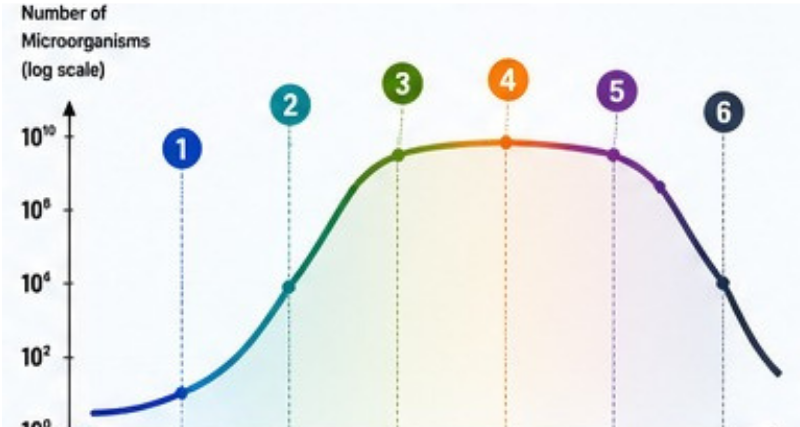
Microbial populations typically follow a predictable growth pattern consisting of six phases:
1. Lag Phase
Cells adapt to the environment, with minimal multiplication occurring during this initial stage.
2. Accelerated Phase
Growth mechanisms become active, and the rate of cell division begins to increase.
3. Exponential Phase
Microorganisms multiply rapidly, with the population doubling repeatedly over time.
4. Decelerated Phase
As nutrients become limited and environmental conditions change, microbial growth begins to slow.
5. Stationary Phase
The rate of new cell formation becomes balanced with cell death, causing the population to stabilise.
6. Death Phase
Cells die at a faster rate than they reproduce, resulting in a decline in the microbial population.
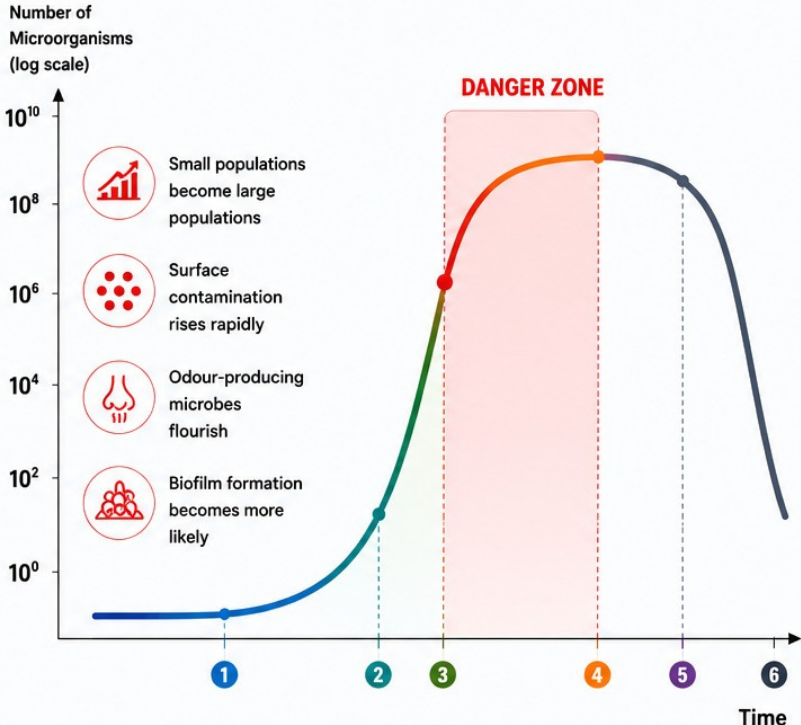
During this phase, microbial populations multiply rapidly. Even a small surviving population can grow into a much larger microbial population, increasing the risk of contamination. As microbial numbers rise, surface contamination can increase, odour-producing microbes may flourish, and biofilm formation becomes more likely.
As microorganisms grow, their metabolic activity increases, breaking down organic matter and producing volatile compounds that cause unpleasant odours.
Even when surfaces appear clean, odour-causing bacteria can rapidly proliferate, particularly in warm, damp, or poorly ventilated environments. Organic residues such as perspiration, skin cells, and food particles provide nutrients that support microbial growth, allowing microbial populations to increase and unpleasant odours to develop.
Materials such as fabrics, plastics, and surface coatings are particularly vulnerable to microbial contamination, as their textures and absorbency provide favourable conditions for microbial growth.

Traditional cleaning approaches focus only on reducing microbial counts to safe levels, but surfaces can still be prone to recontamination.
An advanced approach focuses on slowing microbial growth by:
Extending the lag phase
Delaying the period where microorganisms adapt before active multiplication begins.
Delaying exponential growth
Reducing the speed at which microbial populations rapidly increase.
Reducing odour recurrence
Helping reduce the return of unpleasant odours associated with microbial activity.